In the hushed, expectant atmosphere of a Parisian auction house, a singular event is poised to unfold, one that promises to recalibrate the very frequencies of the art market. The upcoming sale of a monumental work by Georges Mathieu, the incendiary titan of Lyrical Abstraction, is not merely a transaction but a profound cultural moment. The painting, a tempestuous symphony of paint titled French Aviation, stands as a testament to an era of unbridled creative fervor and a artist who painted not with brushes, but with the very pulse of existence.
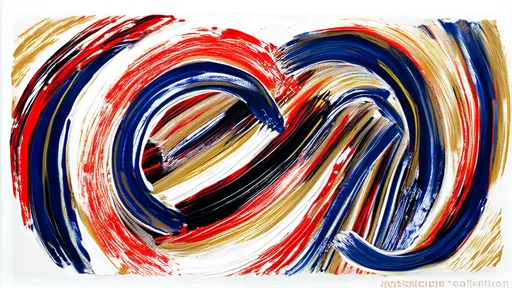
To speak of Mathieu is to speak of performance, of velocity, of a metaphysical confrontation with the canvas. Emerging in the post-war ashes of Europe, he became the French answer to American Action Painting, yet his methodology and philosophy were distinctly his own. Where his counterparts across the Atlantic often delved into the subconscious, Mathieu’s approach was more akin to a calligraphic ritual, a direct transfer of psychic energy onto the surface. He worked with a breathtaking speed that bordered on the ecstatic, applying paint directly from the tube in swift, decisive gestures that left behind a trail of vibrant, writhing forms. His were not paintings composed; they were events captured, frozen explosions of pure painterly incident.
The work on offer, French Aviation, is a pinnacle of this practice. Its scale is immersive, demanding a physical response from the viewer. The canvas is a field of deep, resonant color—perhaps a midnight blue or a sanguine red—upon which Mathieu has orchestrated a ballet of pure line. Thick, impastoed ridges of white, yellow, and black paint weave and dart across the surface. These are not arbitrary marks; they possess the urgency of ancient sigils and the elegant flow of Eastern calligraphy. The title itself is a key to its interpretation. This is not a literal depiction of an aircraft, but an evocation of its essence: the sensation of speed, the defiance of gravity, the sheer, audacious power of flight translated into a visual language. It is a painting that does not represent movement; it is movement.
This auction arrives at a moment of significant reappraisal for the School of Paris and particularly for the Lyrical Abstractionists. For decades, the narrative of post-war art has been dominated by the New York School—Pollock, de Kooning, Rothko. But a growing chorus of curators, critics, and collectors is now looking back across the Atlantic, recognizing the radical and deeply personal contributions of European artists like Mathieu, Pierre Soulages, and Hans Hartung. They are seen not as followers, but as pioneers of an alternative modernism, one rooted in a different cultural and philosophical soil. The market, always sensitive to these scholarly shifts, is beginning to reflect this renewed interest. Prices for major works by these artists have been climbing steadily, yet they often remain undervalued compared to their American contemporaries, presenting a tantalizing opportunity for astute collectors.
The significance of French Aviation extends beyond its aesthetic power and into the very heart of art historical discourse. Mathieu positioned himself as a heir to a long tradition of French painting that valued elegance, speed, and intelligence—what he termed "la vitesse." He saw his work as a continuation of the legacy of artists like Eugène Delacroix, whose own fiery romanticism sought to capture the sublime. In Mathieu’s rapid-fire application of paint, one can detect a modern, accelerated version of the Romantic spirit, a desire to seize the moment of creation itself and hold it fast. This painting, therefore, is a crucial link in a chain that connects the 19th century’s passion with the 20th century’s existential angst.
Furthermore, the theatricality of Mathieu’s practice—he famously painted before live audiences, a kind of artistic shaman—anticipates much of the performance art that would flourish in subsequent decades. French Aviation is not just an object; it is the relic of a profound action. Every loop and slash of paint is a fossilized gesture, a permanent record of the artist’s physical and emotional state at a specific moment in time. To own such a work is to possess a piece of that history, a direct connection to the artist’s creative act.
As the gavel prepares to fall, the art world holds its breath. The sale of this Mathieu masterpiece is more than a highlight of the auction season; it is a barometer of changing tastes. A strong result will signal a definitive and long-overdue correction in the market, affirming the central role of Lyrical Abstraction in the story of 20th-century art. It will acknowledge that the most powerful statements are not always the most calculated, that beauty can reside in the controlled chaos of a gesture made at speed, and that the force of human expression, when channeled with such conviction, can indeed take flight. French Aviation is not just a painting to be acquired; it is an energy field to be experienced, a soaring testament to the lyrical power of the abstract.
By /Sep 25, 2025

By /Sep 25, 2025
By /Sep 25, 2025

By /Sep 25, 2025

By /Sep 25, 2025
By /Sep 25, 2025

By /Sep 25, 2025
By /Sep 25, 2025

By /Sep 25, 2025

By /Sep 25, 2025
By /Sep 25, 2025
By /Sep 25, 2025

By /Sep 25, 2025

By /Sep 25, 2025

By /Sep 25, 2025
By /Sep 25, 2025
By /Sep 25, 2025

By /Sep 25, 2025

By /Sep 25, 2025

By /Sep 25, 2025
