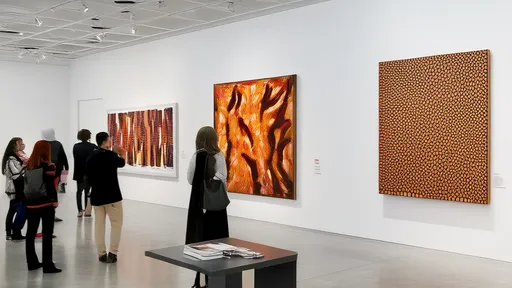
In the hushed, hallowed halls of a Geneva free port, art historians have made a discovery that promises to recalibrate our understanding of one of the 20th century's artistic giants. A cache of previously unseen works by the legendary Franco-Chinese painter Zao Wou-Ki, created in the pivotal year of 1948, has been brought to light. These paintings, drawings, and sketches, long held within a private European collection, offer an unprecedented and intimate glimpse into the artist's tumultuous first months in Paris, a period that marked the definitive rupture from his past and the hesitant, brilliant beginnings of his unique visual language.
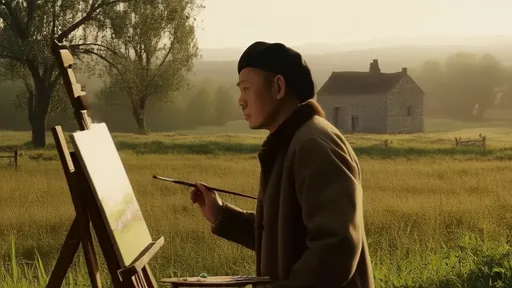
The story of these works begins with a voyage. In February 1948, a young Zao Wou-Ki, then just 27 years old, boarded the SS President Cleveland in Shanghai with his first wife, Lan-lan. He carried with him the classical training of the Hangzhou National College of Art and the burgeoning fame of a prodigy in his homeland. Yet, he also carried a profound dissatisfaction, a yearning to break free from what he saw as the constraints of both Chinese traditional painting and the Western-style academic art taught in China. Paris, the fabled capital of modern art, was his destination. The works discovered in Geneva are the direct, visceral record of that journey and its immediate, disorienting aftermath.
The Geneva collection is remarkably diverse, comprising over two dozen pieces. There are small, delicate ink wash studies on paper that still bear the clear influence of Sung Dynasty masters, their subjects—a sparrow on a branch, a misty mountain range—rendered with a confident, inherited grace. But placed beside these are bold, experimental oil sketches on cardboard, where Zao first grapples with the thick impasto of Nicolas de Staël and the fractured light of Paul Klee. One particularly striking piece, a small portrait of Lan-lan, shows her face constructed from a mosaic of muted, earthy tones, a clear departure from the lyrical realism of his pre-departure work. It is a face full of the anxiety and anticipation of their new life.
Perhaps the most significant works in the trove are a series of abstracted cityscapes. These are not the romantic, postcard views of Paris that a tourist might paint. Instead, they are jarring, angular compositions. The Eiffel Tower is reduced to a skeletal lattice of frantic black lines against a sulphurous yellow sky; the rooftops of Montparnasse become a chaotic jumble of grey and brown geometric shapes, as if seen through a fractured lens. Art critic and Zao specialist, Dr. Élise Laurent, who was granted early access to the collection, describes these works as "topographical maps of a psychic state." She explains, "We are witnessing the visual equivalent of sensory overload. Here is a young artist, inundated by a new visual culture, a new language, a new everything. These paintings are not about Paris itself, but about the act of seeing Paris for the first time. The distortion is the truth of the experience."
This period of intense experimentation was fraught with personal struggle. Zao spoke little French upon arrival and funds were scarce. The couple lived in a small, unheated hotel room near Place d'Italie. The Geneva sketches include several poignant still lifes of their meager possessions: a single bowl, a teapot, a pair of shoes by the door. These mundane objects are rendered with a weight and solemnity that speaks volumes about the isolation and hardship of those early days. Yet, alongside the struggle, there is also evidence of burgeoning connections. One charcoal drawing is a quick study of his friend and fellow artist, Alberto Giacometti, his gaunt features captured in a few swift, energetic lines. Another shows the interior of the famed Académie de la Grande Chaumière, where Zao briefly enrolled, filled with the ghostly forms of life models and easels.
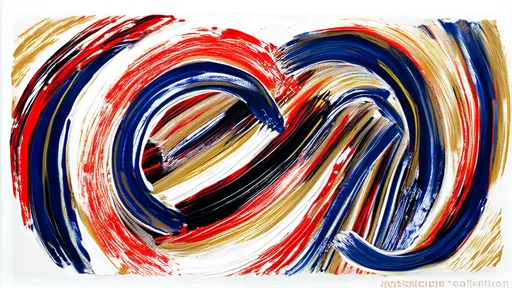
The year 1948 is critical in the Zao Wou-Ki chronology precisely because it is a year of becoming. By the end of 1949, his style would begin to coalesce into the more recognizable, cosmic abstractions that would make him famous. The calligraphic impulses of his Chinese heritage would start to merge seamlessly with the colour-field sensibilities of Western abstraction. But the Geneva works show us the messy, beautiful, and uncertain genesis of that fusion. They are the "before" picture. In one fascinating ink drawing, Chinese characters from a classical poem are half-obscured by a wash of grey, as if the artist is literally painting over his textual past. In another oil study, he attempts to translate the concept of "qi," or life force, into purely abstract forms of swirling colour, a project that would consume him for decades to come.
The emergence of this collection does more than just add new entries to Zao Wou-Ki's catalogue raisonné; it fundamentally enriches the narrative of his artistic evolution. It provides tangible proof of the difficult, non-linear path of creative growth. We see that the journey from Hangzhou to global abstraction was not a single leap, but a painful, exhilarating, and deeply human series of stumbles and breakthroughs. These works, frozen in time from 1948, are the authentic, unvarnished testimony of an artist at the most vulnerable and formative crossroads of his life. They are not masterpieces in the conventional sense, but they are arguably more valuable: they are the seeds from which a master's legacy grew.
The current owner of the collection has chosen to remain anonymous, and the works are undergoing conservation and authentication. However, plans are already underway for a major international exhibition focused solely on this pivotal year, scheduled for 2025. For scholars and admirers of Zao Wou-Ki, the wait to see these remarkable documents of an artistic birth will be interminable. But when they are finally unveiled to the public, they will not just be displayed; they will be witnessed, offering a rare and profound opportunity to stand beside a young artist as he steps into the unknown, brush in hand, and begins to change the world of art forever.
By /Sep 25, 2025
By /Sep 25, 2025
By /Sep 25, 2025
By /Sep 25, 2025
By /Sep 25, 2025
By /Sep 25, 2025

By /Sep 25, 2025
By /Sep 25, 2025
By /Sep 25, 2025
By /Sep 25, 2025
By /Sep 25, 2025
By /Sep 25, 2025
By /Sep 25, 2025
By /Sep 25, 2025

By /Sep 25, 2025
By /Sep 25, 2025
By /Sep 25, 2025
By /Sep 25, 2025
By /Sep 25, 2025
By /Sep 25, 2025
